


- Context
- 131K
- Price / 1M
- $0.025 in$0.149 out
- Precision
- 4 bits
The Third Dimension of OptimizationPowered by Reconfigurable Processors
Bespoke Processor Per Model, Higher Interactivity, Lower Energy, Cheaper, Faster, Accurate AI Inference
ML Optimizations Arrive Daily. Custom Silicon Takes Years.
Without Elastix, Today’s AI is Running on Yesterday’s Hardware.
ElastixAI: processor, ML optimizations, & serving software co-designed as a unified stack.
ElastixAI reconfigurable inference processor
One processor adapts to Dense Models, MoE Models, and Future Models. Dense models use connected layers; mixture-of-experts models route work to selected experts; future models are represented by adaptable modules, not a prediction of a specific architecture. Compute tiles change pattern and height to illustrate reconfiguration, then inference output flows. Tile colors and heights are illustrative, not performance measurements.
Ready to run
Popular models.
- Context
- 131K
- Price / 1M
- $0.095 in$0.395 out
- Precision
- 4 bits

- Context
- 262K
- Price / 1M
- $0.264 in$2.909 out
- Precision
- 4 bits
- Context
- 262K
- Price / 1M
- $0.088 in$1.03 out
- Precision
- 4 bits

- Context
- 262K
- Price / 1M
- Coming soon
- Precision
- 4 bits

- Context
- 262K
- Price / 1M
- Coming soon
- Precision
- 4 bits
- Context
- 262K
- Price / 1M
- Coming soon
- Precision
- 4 bits
- More tokens per dollar
- × +
- Lower power consumption
- Up to%
- Models. Software. Hardware.
- .
Frequently asked questions
Exploring a specific workload? We’re happy to talk through the details.
Ask our teamCan I try ElastixAI for free?
Yes. Try a limited conversation on our home page. For more extensive use, credits can be purchased at https://elastix.ai/dashboard.
Do I need to manage hardware or learn a new framework?
No. Tokens as a Service gives you hosted inference through chat and a familiar API. For on-premise deployments, the PyTorch-compatible flow is designed to replace your existing GPU flow without requiring you to program an FPGA.
Which models does ElastixAI work with? What does “model agnostic” mean?
Any open- or closed-source model runs well on ElastixAI reconfigurable inference processors. Of course, any closed-source model must be appropriately licensed, but that’s a contractual not a technical issue.
How is 5–10× lower energy per token possible?
Three things compound. A bespoke processor per model wastes no silicon or power on generality. Hardware support lets the model use modern ML efficiency techniques, so each token costs fewer operations. And the serving framework is co-tuned to both. Energy is OpEx and a hard physical constraint, which makes this a CFO-level argument as much as an engineering one.
Why is this approach feasible now?
Two inflection points. FPGAs now beat GPUs on cost per GB of memory connected and per GB/s of bandwidth — the features that matter most for inference TCO. And ElastixAI has automated FPGA reconfigurability in a fully PyTorch-compatible flow to make the use of FPGAs instead of GPUs completely transparent. No FPGA knowledge whatsoever is needed to use Elastix reconfigurable processors.
What’s new at ElastixAI
All blog posts
From Telephones to Transformers: A Brief History of Quantization
Model quality used to be AI’s limiting factor. Now, it’s model economics. Where cost per token, watts per rack, and tokens per second dominate the conversation, no topic is more pertinent than model optimizations. And, in that conversation, few optimizations are as well-known, and as misunderstood, as quantization.
The AI Data Center Economy Runs on Tokens per Second per Watt
In early 2026, Microsoft disclosed an $80 billion unfulfilled Azure order backlog due to insufficient electricity to power the deployments. CEO Satya Nadella confirmed on the record that their GPUs are sitting idle in inventory, waiting for installations that can’t proceed until the grid can deliver the load.
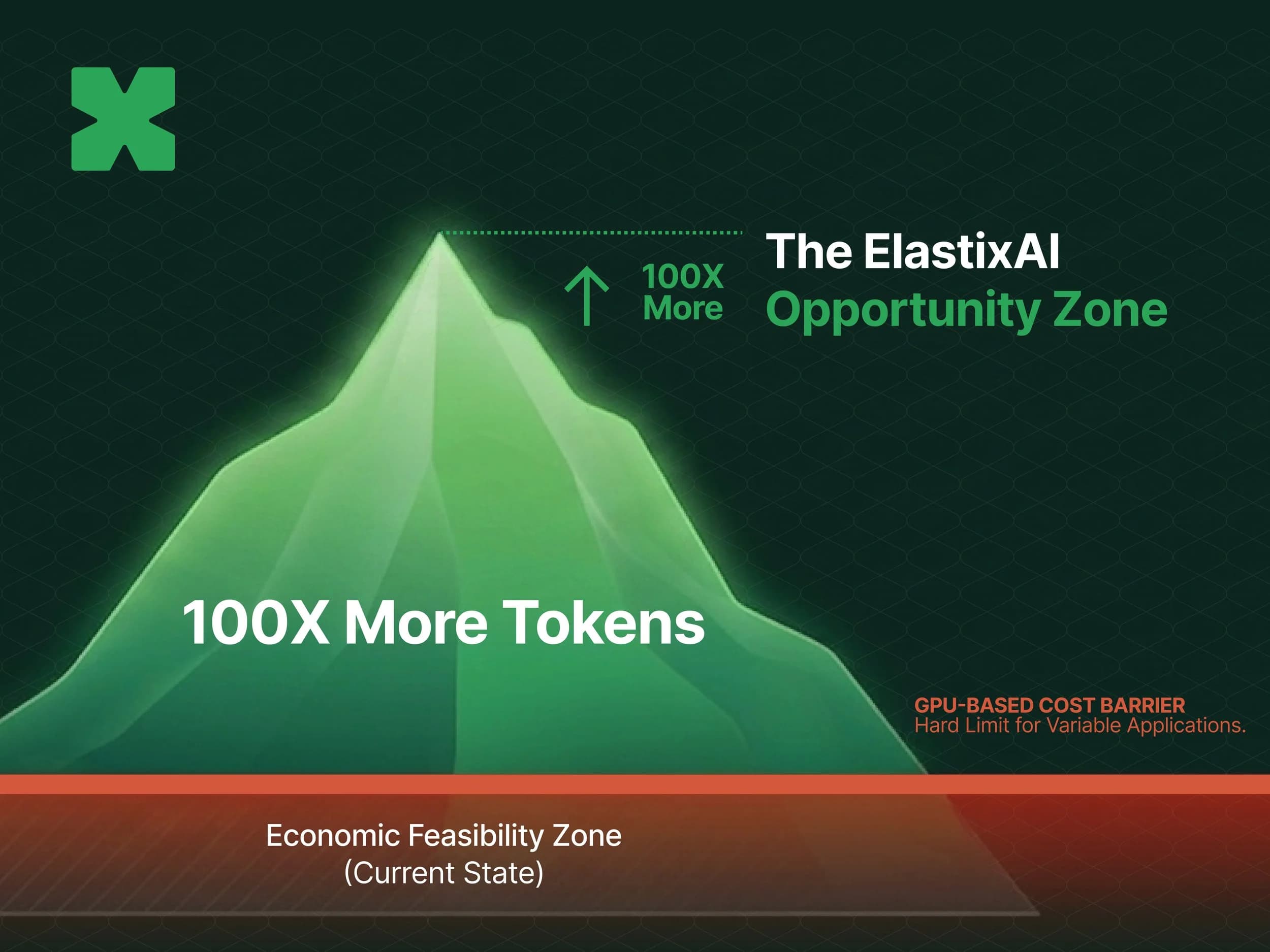
What Becomes Possible With 100x More Tokens?
What if we could generate 100x more tokens for the same budget? What new possibilities and world-changing applications would open up if the cost of AI stopped being the deciding factor?

The Inference Economy: LLM Inference Is Everywhere, Not Just in Your Chatbot
When most people think of Large Language Models (LLMs), they think of chatbots. However, this perspective drastically understates the true scope and technical necessity of the inference market. Inference is much more than typing a prompt and receiving a response. In reality, it’s become a basic compute primitive that powers the entire AI lifecycle.